
Most teams do not lack problem solving ability. They lack a shared method, so every problem gets solved by whoever is most confident that day. A named technique does two things: it makes the group's reasoning visible, and it gives quiet people a way in.
Here are eight problem solving techniques that work in a real meeting with a whiteboard and an hour, with an example of each, followed by the activities we use to build the same skill under pressure.
Pick the technique by the type of problem
•You do not know what is causing it: use the five whys or a fishbone diagram.
•You have too many options: use impact and effort, or dot voting on a long list.
•You have no options: use brainwriting or reverse brainstorming.
•You are about to commit and want to be sure: use a pre-mortem.
•You have a position to argue: use the six thinking hats, or a structured debate.
1. The five whys
Ask why five times, each time using the previous answer. It is crude and it works: most teams stop at the second why, which is usually where the symptom lives rather than the cause.
Example: client complaints are up. Why? Deliveries are late. Why? The warehouse runs out of stock. Why? Reorder points were set for last year's volumes. Why? Nobody owns the reorder point calculation. Why? The role that used to own it was made redundant. The fix is a role, not a delivery process, and no amount of delivery improvement would have found it.
2. Fishbone (Ishikawa) diagram
A cause and effect diagram with the problem as the head and four to six categories, such as people, process, technology, environment, as the bones. Each team adds causes onto the bones on sticky notes. It is faster than free discussion for anything with many contributing factors, because it stops the group chasing one branch.
3. Impact and effort matrix
Score every option for impact and effort, then put it on a four-box grid. The quadrant that matters is low effort, high impact, and the one teams ignore is high effort, high impact, which is where the actual strategy usually lives.
Example: a team drowning in support tickets scores self-service articles (high impact, low effort) alongside a full platform rebuild. The matrix does not pick the answer, but it makes the trade-off visible in a way a discussion never does.
4. Brainwriting (six-three-five)
Six people, three ideas each, five minutes, written individually on paper. Papers rotate and each person builds on the ideas in front of them, two more rounds. It generates 18 starting points in 15 minutes without a single person having to speak first, which is why it beats brainstorming with mixed seniority in the room.
5. Reverse brainstorming
Ask how to make the problem worse, then invert the list. Groups that cannot answer the positive version instantly when they can sabotage the room. It also tends to be funny, which lowers the cost of contributing.
Example: staff are not using the new CRM. How could we guarantee nobody uses it? Make it slower than the old one, let data quality slide, and never show anyone what is in it for them. Inverted, those become the actual adoption plan.
6. The pre-mortem
Assume the project has failed, and write the reason it happened. Unlike risk registers, which are written by the optimistic, the pre-mortem gives permission to be specific about failure before anyone has invested in defending the plan.
7. First principles breakdown
Strip the problem to what is definitely true, then rebuild. It is slower than analogy and worth it once a quarter, because most long-standing internal processes survive on "that is how we have always done it" rather than on a constraint.
8. Structured debate (and the six thinking hats)
Assign positions rather than let people find their own. Two people argue for, two against, one group collects the facts, then everyone argues the opposite of what they started with. It gets to the buried objection in about 20 minutes, where a normal discussion keeps re-stating the same two positions for an hour.
A worked example: a one-hour problem solving session
•0 to 5 minutes: write the problem as one sentence and agree it. Most sessions fail here, by running two problems at once.
•5 to 15 minutes: five whys in pairs, then share. Collect the causes on one wall.
•15 to 30 minutes: brainwriting for solutions, then a dot vote to shortlist three.
•30 to 45 minutes: impact and effort on the three, then pick one to test.
•45 to 60 minutes: pre-mortem on the chosen option, then name the owner and the review date.
Same hour, thirty people, one owner and one review date, instead of a decision that gets remade in three weeks because nobody was sure it had been made.
Why activities build the skill faster than workshops
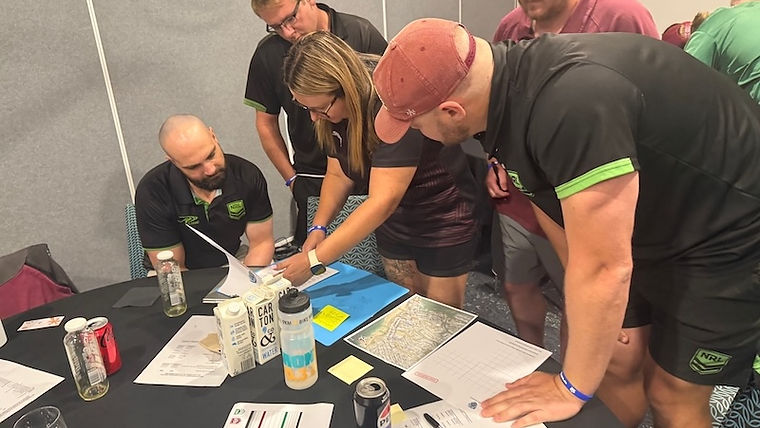
Reading about the five whys changes nothing. Doing a task where the group has 20 sticks of spaghetti and a marshmallow, and watching the clock decide who plans and who builds, changes how the group relates to a deadline for months afterwards.
That is the design principle behind the Team Fun formats: the Taskmaster challenges, the Spy Race and the Amazing Race all create problems with incomplete information, hard time limits and a scoreboard, and then a facilitator debriefs how the team solved them. Teams see their own default method, which is the part a slide deck cannot do. Taskmaster and Spy Race are quoted per event, with a written plan usually within one business day.
Frequently asked questions
What are the most effective problem solving techniques for teams?
The five whys and a fishbone for finding the cause, brainwriting for generating options when the group is stuck, impact and effort for choosing between them, and a pre-mortem before committing. Four of the five take under 20 minutes, which is why they get used.
What is the difference between brainstorming and brainwriting?
Brainstorming is spoken and sequential, so the first confident voice frames the group. Brainwriting is silent and parallel: each person writes ideas, papers rotate and people build on what is already there. Brainwriting reliably produces more ideas and more variety of ideas when a meeting mixes seniority levels.
How long should a team problem solving session run?
One hour is enough if the problem is stated in a single sentence at the start, the technique is chosen in advance rather than debated, and the last fifteen minutes are reserved for choosing an owner and a review date. Most sessions that run long are running two problems at once.
Can problem solving be taught through team building?
Better than through a workshop, because an activity creates a real problem with a real clock and a real audience, then lets a facilitator show the team how it behaved. Team Fun formats such as Taskmaster, Spy Race and the Amazing Race are built for exactly that, followed by a structured debrief.
What is a pre-mortem and why does it work?
A pre-mortem asks the group to imagine the project has already failed and to write the reason. It works because it separates criticism from the plan rather than the person being criticised, so the things everyone privately worries about finally get said while there is still time to act on them.