
Guides
Team Building Cost Per Person in Australia: What Actually Drives the Price
16 November 2026 · 9 min read
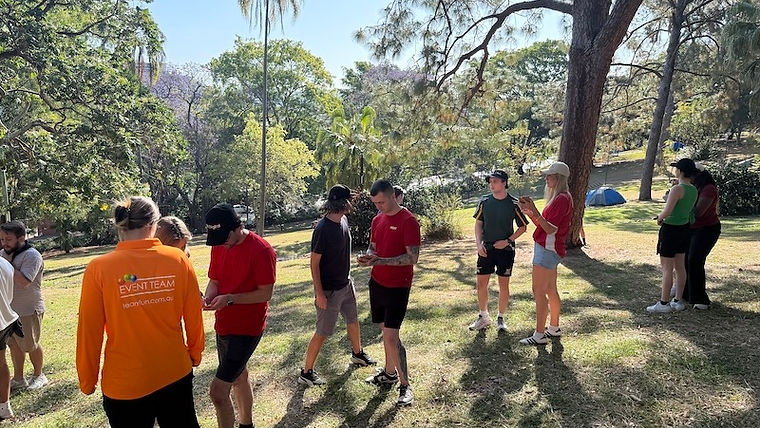
Almost nobody publishes team building prices, and it is not because providers are hiding something. It is because the thing you are buying is a crew, a set of equipment and a designed program, and only one of those three scales with the number of people in the room. A quote for 40 people and a quote for 150 people rarely differ by a factor of four, which confuses buyers who are budgeting per head.
This is the working guide we would give a client who asked how to budget for a team event in Australia: what the price is built from, where it moves, what a cheap quote tends to leave out, and how to turn any quote into a per-person number you can compare.
Two pricing models, and most quotes mix them
Providers generally price one of two ways, and the second is more common than it looks.
•Per person, with a minimum: a rate per participant that only becomes available above a minimum group size, because below that the event does not cover its own costs.
•Per event or program: a flat fee for the format, the crew, the equipment and the planning, with headcount affecting only how many facilitators and how much equipment are needed.
A team building quote in Australia often combines both: a flat program fee plus a per-person component for consumables, catering, venue or transport. Ask which parts of your quote are fixed and which scale with headcount before you negotiate anything, because the answer tells you what changes if three people drop out.
What the number is actually made of
Crew and facilitation
This is usually the biggest single line. One facilitator can generally host 15 to 40 participants depending on the format, so a 120-person event needs three or more hosts, a briefing lead and someone running the scoreboard. Facilitated programs with a debrief cost more than a host who reads out rules, and that difference is real rather than padding.
Equipment, props and consumables
Props are bought per team, not per person, so a 10-team event costs roughly the same in equipment whether each team has four people or eight. This is the single biggest reason a per-person price falls as headcount rises.
Design and planning time
An off-the-shelf format should cost less than a custom route or a themed program built around your conference. If a custom brief costs the same as a standard format, ask what was actually designed.
Venue, catering, AV and transport
These are usually pass-through costs for a third party. A quote that bundles them is more convenient but harder to compare, so ask for them itemised. The same event indoors in a hired function room can cost meaningfully more than the same event in a public park.
Travel and regional logistics
Metro events usually carry crew travel inside the quote. Outside a capital city, or in a location with no local crew, you are paying for travel time, mileage, and sometimes flights and accommodation for the team. This is why a regional quote can be higher than the same format in the CBD.
Insurance, permits and compliance
Public liability cover, working-with-children checks for school and youth events, and council or park permits all cost the provider money. A quote without them usually means the risk has been transferred to you.
How to turn any quote into a per-person number
Do this before you compare anything, because the headline figure hides the real comparison.
•Divide the total, including GST and any travel, by the number of people who will actually attend, not the number invited.
•Do the maths on your realistic headcount rather than the maximum: $4,500 for 30 people is $150 per head, and the same $4,500 spread over 60 people is $75 per head.
•Ask whether the price is fixed or estimated, and what happens to it if headcount drops inside the week before the event.
•Ask whether there is a minimum spend, because it changes the effective rate for smaller groups.
That four-line calculation will rank your quotes more honestly than any comparison table, because it removes the two things that distort them most: GST and minimum spend.
Where costs move the most
•Group size. The fixed costs spread across more people, so the per-head figure drops as the room fills. This is the largest single lever you have.
•City versus regional. Crew travel, flights and accommodation move a regional event up more than any format choice does.
•Day and season. Fridays, December and end-of-financial-year weeks carry a scarcity premium because everyone wants the same dates. A Tuesday in February is the same event for less.
•Duration. Moving from 90 minutes to a full day roughly doubles crew time and often needs a venue and catering, which is where budgets actually break.
•Indoor versus outdoor. Outdoor formats use public space and skip venue hire, but bring weather planning and permits with them.
•Hosted versus self-run. Hosted means crew, design and on-the-day management. Self-run games are the opposite end of the market entirely.
The low end: games you run yourself
Our play-anytime online escape games are the clearest example of the bottom of this market, because the price is published: $30 AUD for Carnival Games and Deep Sea Escape, $35 AUD for Something Strange at Sea, each covering up to 8 players. That works out at about $4 per person, with no crew, no venue and no lead time, because the game link is emailed the moment you pay.
It is a different product rather than a cheaper version of a hosted event, but it is the honest answer when someone asks what the minimum spend can be.
What a cheap quote usually leaves out
Two quotes for the same brief are rarely the same product. The cheaper one is usually missing at least one of these.
•Facilitation. A crew ratio that leaves 60 people with one host means the day runs itself badly.
•A wet weather plan. Rescheduling or pivoting indoors costs the provider money, so it sometimes quietly does not exist.
•A run sheet with timings, which is the difference between an event and a meeting that ends late.
•GST and travel, added after you have mentally committed to the first number.
•Extra hosts for large groups, which is often the first thing cut to hit a budget.
How to compare two quotes fairly
Ask both providers the same seven questions and the comparison usually makes itself.
•Is the price fixed or an estimate, and is GST included?
•How many crew will be on site, and what is the ratio to participants?
•What happens if it rains, and what does that cost?
•What does the quote exclude: venue, catering, AV, transport, permits?
•Is the format designed for this group, or the standard version?
•What is the cancellation and headcount-change policy?
•Who is running the event on the day, and have they run this format before?
What to send us for an accurate price
Team Fun quotes each event individually, because price depends on headcount, format, city and any venue, catering or travel involved. Send seven things and you will get a specific number rather than a range: date or date range, city, headcount, whether you have a venue, the time window you have available, what you want the team to get out of it, and the budget you are working to if you have one.
Quoting and planning advice are free, the quote is fixed once those details are confirmed, and a written plan and price usually come back within one business day. Nothing is charged until you accept it, which means the cheapest way to find out what your event costs is to ask.
A quote you cannot compare is not a price, it is a number. Divide it by real headcount, add what it excludes, and then decide.
Frequently asked questions
How much does team building cost per person in Australia?
It depends on four things: headcount, format, city and what is included. Because most quotes are built per event rather than per person, the per-head figure falls as group size rises. Divide the total including GST and travel by your realistic headcount, and confirm whether venue, catering and crew travel are inside the price. Team Fun quotes each event individually and free, usually within one business day, so you can compare on your own numbers.
Is team building priced per person or per event?
Most hosted team building in Australia is priced per event, with headcount affecting how many facilitators and how much equipment are needed. Per-person pricing usually appears as a rate with a minimum group size, or as a per-head component for consumables, catering and venue. Ask which parts of a quote are fixed and which scale with headcount.
Why is the per-person price cheaper for a bigger group?
Because crew, props and design are largely fixed costs. Equipment is bought per team rather than per person, and one facilitator can host a defined number of participants, so a 120-person event does not cost three times a 40-person event. The per-head figure drops as those fixed costs spread across more people.
What is the cheapest team building option?
Self-run games, because there is no crew or venue to pay for. Our play-anytime online escape games are published at $30 AUD for Carnival Games and Deep Sea Escape and $35 AUD for Something Strange at Sea, each covering up to 8 players, which is about $4 per person with immediate access after payment. A hosted event costs more because you are buying facilitators, equipment and a designed program.
Does the price include GST and travel?
Ask every provider this directly, because it is the most common reason two quotes look further apart than they are. Metro events usually include crew travel; regional and interstate events often add travel time, mileage, flights or accommodation as a separate line. GST treatment should be stated on the quote itself.
How far ahead should we set a team building budget?
Two to four weeks is comfortable for most corporate events in Australia, and a month or more is safer for groups over 100, conference programs and December dates. Budgeting early also buys flexibility on day and season, which affects price more than most format choices do.